On the Greatness of the Magna Carta
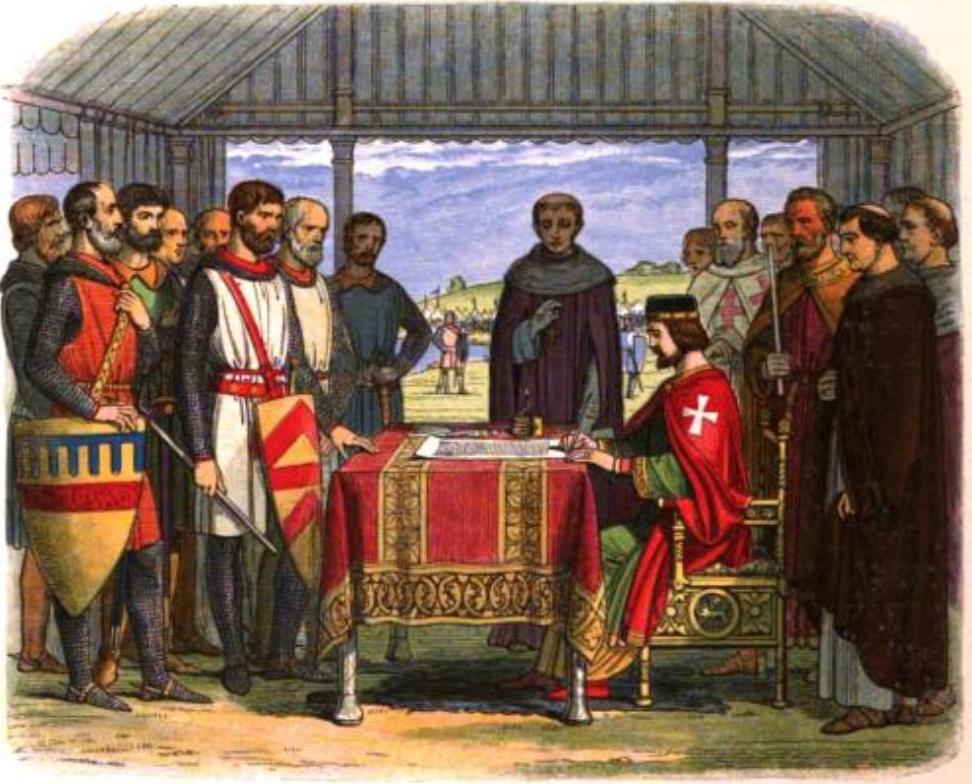
The Magna Carta is the most famous law in history, and yet it is surprisingly under-studied. In fact, I don't remember discussing it at all in either college or law school. As I wrote that sentence, I doubted myself and so, just to be sure, I went and double-checked my constitutional law textbook. I was right. The Great Charter makes no appearance anywhere in its 2,000 pages. I didn't find it in my introductory world history textbook either.
Surely many factors have played a role in the vanishing of the Magna Carta from modern discourse. You will likely have your own ideas about the determining cause (perhaps I was simply bad at choosing courses). But in any case, I think it's a shame. The Magna Carta is a great law, and we can learn much from it.
In the summer of 1215 A.D., King John met his barons at Runnymede, a grassy meadow on the River Thames, to come to an agreement. The barons, who had long grumbled about John's lawless ways, had recently renounced their fealty to him and united against his reign. In a matter of days, the baronial armies, under the leadership of Robert FitzWalter, the so-called "Marshal of the Army of God," seized control of London and other strategic redoubts across the country. King John, with few options, agreed to meet the barons and accept their demands for a new charter of rights.
A dust-up between a dissolute king and his feudal overlords might not strike you as fertile grounds for good lawmaking. But what transformed a civil war into a foundation of modern liberty is that the barons did not frame their demands solely in terms of self-interest. They fought for the rights of all Englishmen.
The Magna Carta begins with the remarkable statement that King John "grants to all the free men of our realm, for us and our heirs, all the liberties set forth in writing below, to have and to hold, by them and their heirs, from us and our heirs, in perpetuity."
King John wasn't just handing out bribes to earls and barons. He was establishing rights for all free men of the realm, and the rights were to last "in perpetuity."
What were those rights? There were many of them, including an evocative prohibition of "all evil customs of the forest," but two stand out for their breadth and their ambition. Articles 39 and 40 state:
No free man shall be taken or imprisoned or dispossessed of property or outlawed or exiled or in any way ruined, nor will we use force of arms against him, except by the lawful judgment of his peers or by the law of the land.
To no one will we sell, and to no one will we deny or delay, right or justice.
One could write entire books on these two sentences. They set out, eloquently and briefly, eternal principles of justice. Justice is not something that can be bought. It is not the personal property of the king. Citizens have fundamental rights that must be respected by all. And the greatest shield against unjust persecution is the judgment of one's peers.
To enforce these provisions, the Magna Carta also created a new institution, a committee of twenty-five barons, who had the power to watch over the king and make sure that he enforced the law. It looked an awful lot like a parliament.
The Magna Carta was not a very effective law, at least at the beginning. A few weeks after placing his royal seal on it, King John revoked the charter, and war broke out anew.
But good ideas are hard to defeat. When John died in 1216 A.D., his successor, Henry III, reissued the charter, as did future kings. The Magna Carta had become the law of the land and would influence English politics for centuries to come. In William Stubbs' monumental three-volume Constitutional History of England, he states simply that "the whole of the constitutional history of England is little more than a commentary on Magna Carta."
The law would also play an important role in shaping the thought of American revolutionaries. When Benjamin Franklin was called before the House of Commons in 1766 to defend the colonies' resistance against British taxation, he asserted that the colonists were entitled to all the privileges and liberties of English citizens. Among those privileges was the right not to be taxed but by their own consent. The confused interrogator asked him where he found that right. Franklin had a ready answer.
"The common rights of Englishmen, as declared by Magna Carta."