On Civil Rights
What are we talking about when we talk about civil rights?
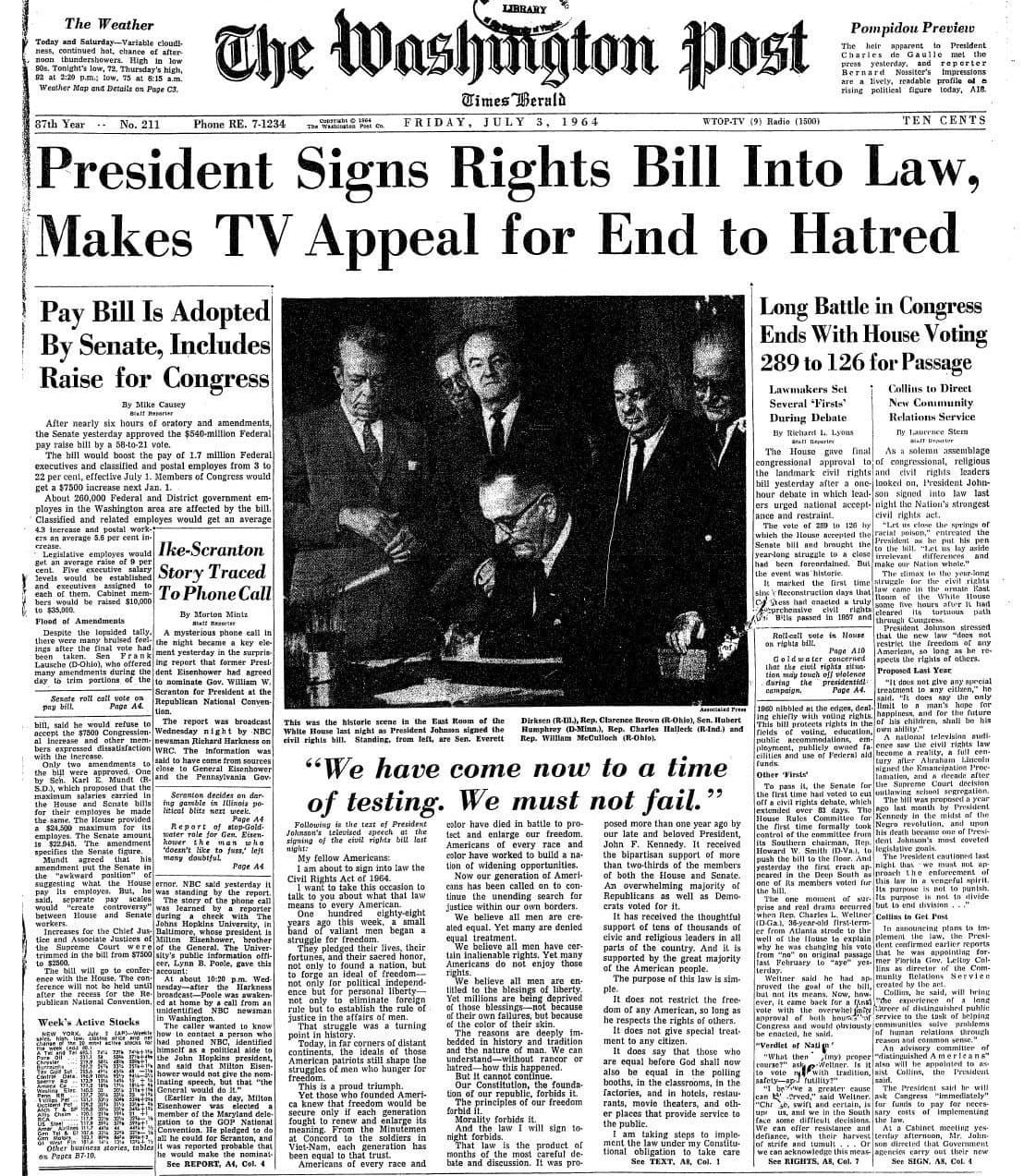
Most Americans understand civil rights in terms of the right to be free from discrimination: the government must not treat people differently based on certain protected characteristics, such as race, sex, religion or national origin. Civil rights in the popular mind, then, are deeply connected with the Civil Rights Movement of the 1950s and 1960s, which pushed for the end of racial segregation and other forms of discrimination, and the Civil Rights Act of 1964, which forbade racial discrimination in public accommodations.
But civil rights have a much longer history than that. The Civil Rights Act of 1964 was the last of a string of civil rights acts: there was a Civil Rights Act of 1960, a Civil Rights Act of 1957, a Civil Rights Act of 1875 and a Civil Rights Act of 1866. Each of these purported to protect civil rights, but defined those rights in dramatically different ways. The 1957 and 1960 Acts focused on voting rights. The 1875 Act focused on access to inns, theaters and "places of public amusement." The 1866 Act focused on the right to make contracts, to buy and sell property and to sue in a court of law. The civil rights that these various acts protected were not so much an analytical category as a running tally of the many ways in which African Americans were treated as unequal citizens.
Outside the United States, though, civil rights had a different meaning. The Napoleonic Code, enacted in 1804, begins, in Book I, Title I, Chapter I, with the axiomatic statement: "All Frenchmen shall enjoy civil rights." Napoleon decidedly did not mean by this that racial discrimination was illegal. In fact, just two years previously, he had reinstated slavery in the French colonies. Instead, civil rights meant rights protected by civil law, that is, the law governing private relations such as property, family and contract.
Perhaps the easiest way to understand what a civil right is, then, is to understand what it is not. In other words, what other categories of rights are there? In his influential 1839 dictionary of American law, John Bouvier wrote that there were three types of rights. There were natural rights, like the right to life and liberty, the things that we think of as being unalienable. There were political rights, like the right to vote and to be elected, that involved the "establishment or management of government." And then there were civil rights, which "consist in the power of acquiring and enjoying property, of exercising the paternal and marital powers, and the like."
So there you have it. Historically, civil rights were understood as rights involving interactions between individuals and their property and were distinguished from other types of rights such as fundamental rights and democratic rights. Over time, though, this conception of civil rights has evolved and expanded.
You might be asking yourself why any of this matters. Who cares what Napoleon thought a civil right was? Who cares how it was defined two centuries ago in an obscure American legal dictionary? What matters is how it is defined today. Right?
It matters, in my opinion, because it helps us understand how innovative the Civil Rights Act of 1964 was. The act fundamentally changed how we view the rights of citizens. Citizens do not just have a right to life and liberty. They also have a right to be treated equally, without regard to the color of their skin or their sex or their religion. That right binds governments, but it also binds private individuals as well.
Title II of the Civil Rights Act provides that all persons are entitled to the full and equal enjoyment of "public accommodations" without discrimination or segregation on the ground of race, color, religion or national origin. Public accommodations are defined by a long list of businesses, including inns, hotels, motels, restaurants, cafeterias, lunch counters, soda fountains, motion picture houses and theaters. Civil rights impose duties on society to treat people equally.
President Lyndon B. Johnson explained this motivation when he signed the act:
The purpose of the law is simple. It does not restrict the freedom of any American, so long as he respects the rights of others. It does not give special treatment to any citizen. It does say the only limit to a man's hope for happiness, and for the future of his children, shall be his own ability. It does say that there are those who are equal before God shall now also be equal in the polling booths, in the classrooms, in the factories, and in hotels, restaurants, movie theaters, and other places that provide service to the public.